close
Choose Your Site
Global
Social Media
Foachi Hardware offers a professional-grade selection of high-performance door hinges, engineered for long-lasting reliability, smooth door operation, and secure load-bearing support. Whether you’re upgrading interior doors, installing new commercial entrances, or sourcing hardware for large-scale building projects, our hinge collections deliver exceptional quality backed by precision manufacturing.
Our main hinge offerings include:
Steel Hinges – economical, durable, and ideal for standard interior or utility doors
Stainless Steel Hinges – corrosion-resistant hinges suitable for coastal areas, humid environments, and premium projects
Each hinge is manufactured with strict quality control, ensuring quiet movement, stable alignment, and extended service life.
| Feature | Steel Hinges (Carbon Steel / Mild Steel) | Stainless Steel Hinges (SS201 / SS304 / SS316) |
|---|---|---|
| Corrosion Resistance | Low to medium; requires plating (zinc, nickel, black) | Excellent; naturally rust-resistant even in humid or coastal areas |
| Strength & Load Capacity | High strength but can weaken with rust | Very strong; retains strength long-term |
| Durability | Depends on coating; coating may wear over time | Superior long-term durability; ideal for heavy use |
| Indoor / Outdoor Use | Best for indoor applications | Suitable for indoor, outdoor, and high-moisture environments |
| Maintenance | Requires periodic cleaning and protection from rust | Minimal maintenance; easy to clean |
| Cost | More affordable | Higher cost due to premium material |
| Finish Options | Wide range: black, bronze, brass, antique, nickel, etc. | Usually satin, polished, matte black, PVD options |
| Best For | Interior doors, budget projects, decorative hinges | Exterior doors, bathrooms, kitchens, commercial buildings |
| Security Level | Good (depends on thickness) | Excellent, especially for front doors and high-traffic applications |
| Resistance to Chemicals & Acids | Moderate | Very high |
| Lifespan | 5–10 years (depending on moisture exposure) | 15–30+ years (marine-grade SS316 lasts longest) |
All hinges are engineered with precise pivot points to ensure silent, friction-controlled door movement.
Reinforced knuckles and optimized thickness deliver dependable strength for wooden, metal, or fire-rated doors.
Choose from steel hinges with protective coatings or full stainless steel hinges for superior resistance to rust and wear.
Available in polished, satin, matte black, electroplated, or custom finishes to match modern architectural styles.
Designed with pre-drilled countersunk holes for fast and secure mounting.
Below is a clean, conversion-focused layout to guide visitors toward the correct hinge type.
Durable, budget-friendly, widely used in interior residential and commercial spaces.
Explore → Steel Hinge Collection
Best for bathrooms, kitchens, coastal climates, hotels, hospitals, and high-end projects.
Explore → Stainless Steel Hinge Collection
Steel Hinges
Stainless Steel Hinges
Our hinges are engineered for versatile use across multiple industries:
Bedrooms, bathrooms, kitchens, and utility rooms
Offices, schools, retail shops, hotels
Public buildings, industrial facilities, safety doors
Bathrooms, locker rooms, coastal homes (Stainless Steel Hinges recommended)
Closets, storage units, light-duty doors
Here is a simple selection guide to help customers decide:
Choose Stainless Steel Hinges if you need corrosion resistance, long service life, or installation near moisture.
Choose Steel Hinges when you need a strong, cost-effective hinge for standard interior use.
Heavier or thicker doors require:
✔ Thicker hinges
✔ More knuckles
✔ Stainless steel for extra load capacity
Match hinge finish with:
Door handle color
Room design style
Hardware sets
Common hinge types available:
Standard butt hinges
Ball-bearing hinges
Spring hinges
Concealed hinges (custom options available)
| Finish Type | Characteristics | Examples from Your Gallery | Best Applications |
|---|---|---|---|
| Matte Black Hinges | Modern, minimal, finger-print resistant | Black 4BB hinge | Contemporary interior doors |
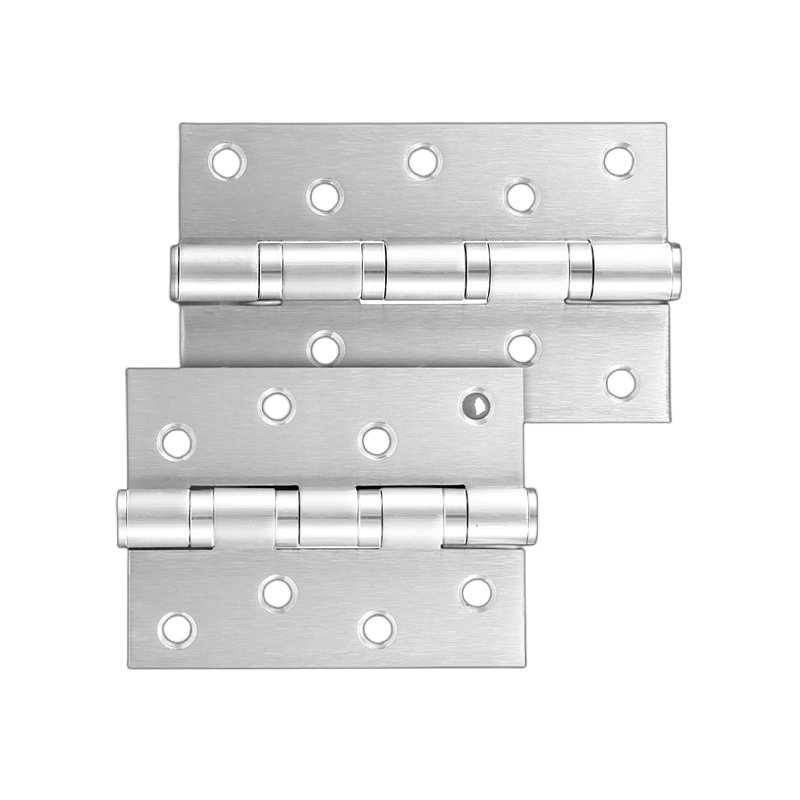
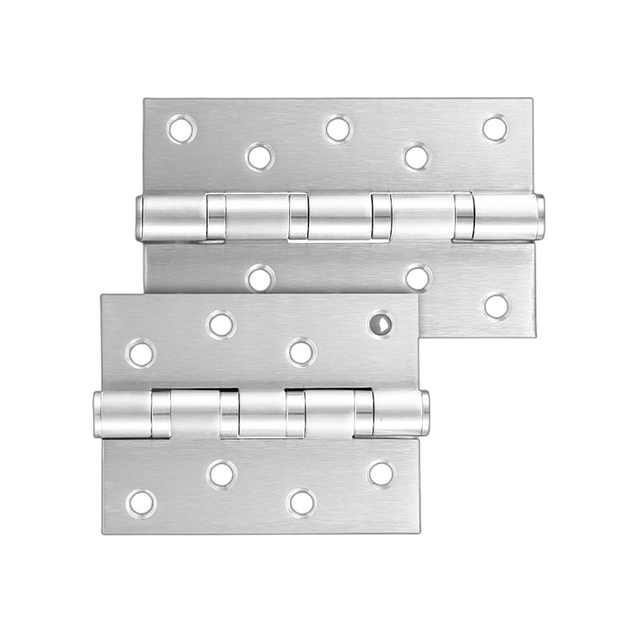
| Satin Stainless Steel Hinges | Smooth silver tone, modern look | SS 2BB, 4BB hinges | Kitchens, bathrooms, modern homes |
| Polished Stainless Steel Hinges | High-gloss mirror finish | Polished SS hinges | Decorative interior doors |
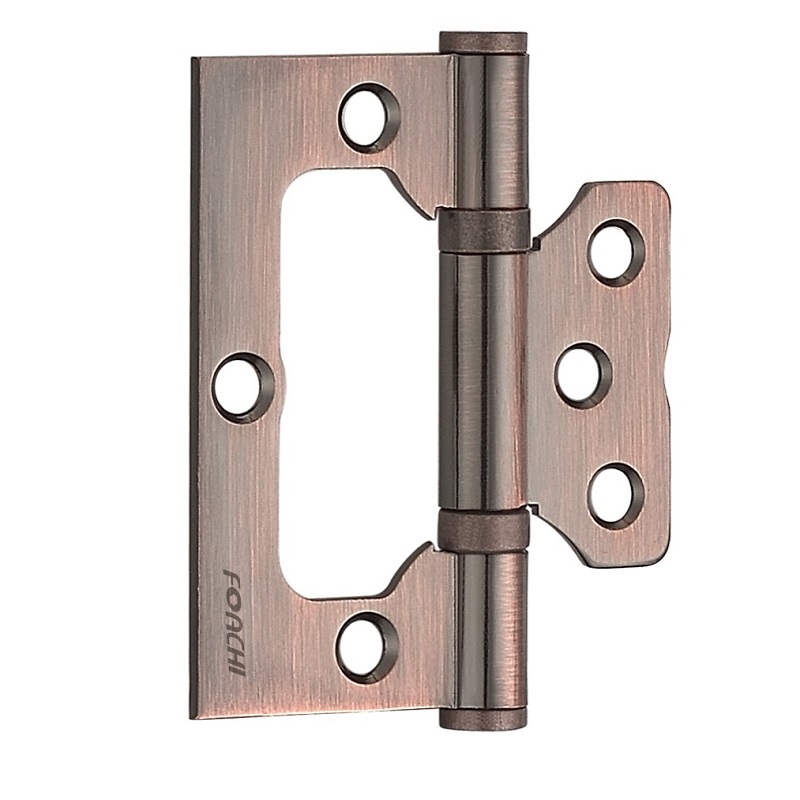
| Antique Bronze / Copper Finish | Warm vintage tone | Brown/bronze hinges | Classic & vintage-style wooden doors |
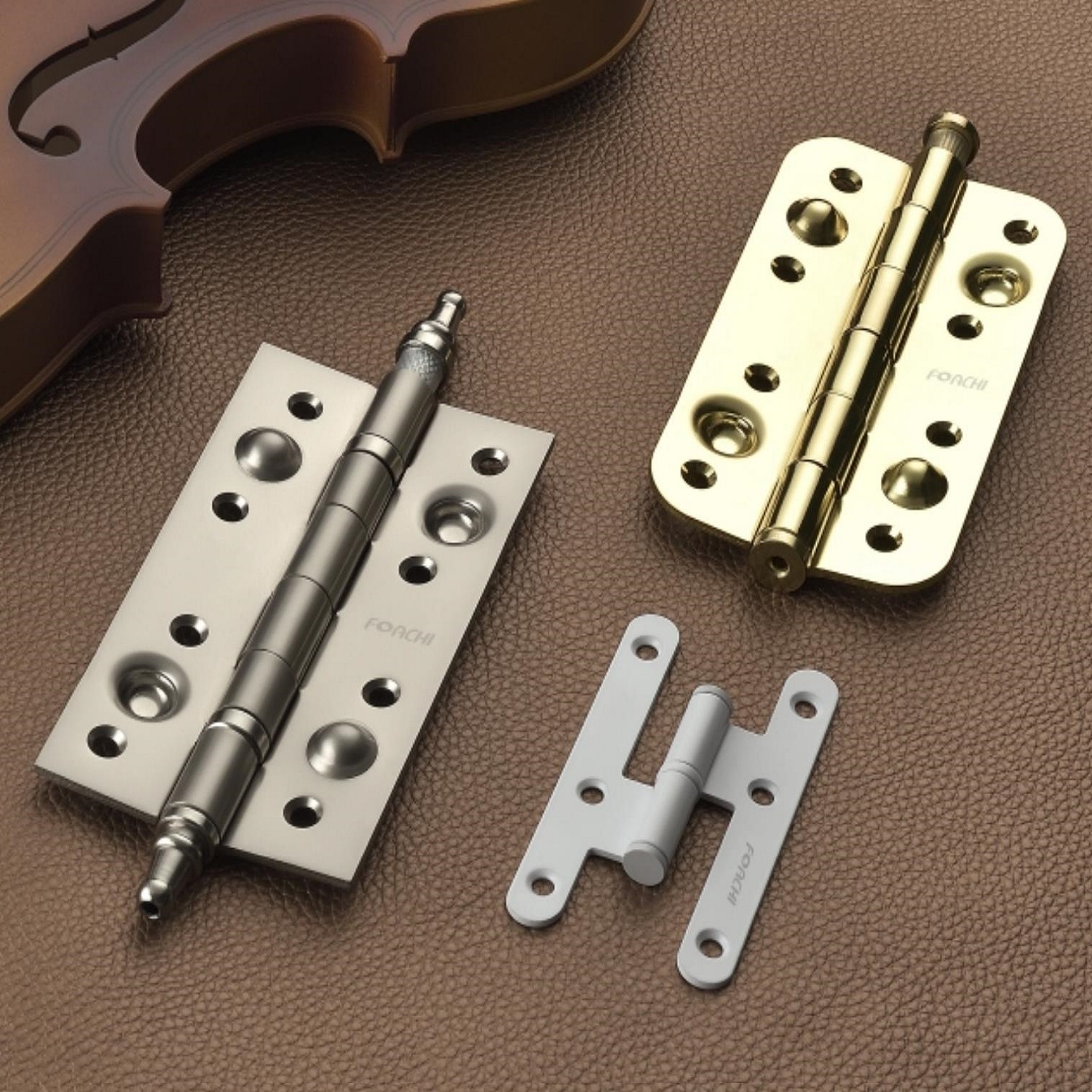
| Gold / Brass Finish Hinges | Luxurious golden tone | Gold 1BB, 2BB, CHP hinges | High-end interiors, hotels |
| White Powder-Coated Hinges | Clean, minimal | White 4” x 3.5” hinges | Light-colored doors, modern décor |
| Knuckle Type | Description | Durability | Visible in Product Images | Recommended Use |
|---|---|---|---|---|
| 1BB (Single Ball Bearing) | One ball-bearing for smoother movement | Medium | Multiple 1BB hinges | Interior wooden doors |
| 2BB (Double Ball Bearing) | Stronger, smoother operation | High | Several 2BB models | Heavier internal doors |
| 4BB (Four Ball Bearings) | Maximum smoothness, heavy-duty | Very High | Black FHP Φ10.9, SS Φ11.5 | Commercial doors, high-traffic areas |
| CHP (Cap Hinge Pin) | Decorative hinge pin head | High | Gold CHP hinge | Decorative or luxury applications |
| Plate Type | Visual Characteristics | Examples from Your Images | Benefits |
|---|---|---|---|
| Standard Rectangular Hinges | Clean rectangle, straight edges | Most stainless, black, white hinges | Universal fit |
| Wide-Leaf Hinges | Wider plates than standard | Some gold & bronze hinges | Added stability |
| Narrow-Leaf Hinges | Slim plates | Light-duty hinges | Suitable for thin doors |
| Decorative Cutout Hinges | Unique outline, curved cutouts | Gold hinge with shaped edges | Aesthetic enhancement |
| Rounded Corner Hinges | Slightly rounded plate corners | Some SS models | Prevents sharp edges |
| Square Corner Hinges | Sharp 90° corners | Majority of steel hinges | Strong, traditional look |
| Hole Type | Pattern Description | Examples Seen | Door Compatibility |
|---|---|---|---|
| 4-Hole Hinges | 2 holes per leaf | White 4"x3.5" hinges | Lighter doors |
| 6-Hole Hinges | 3 holes per leaf | Stainless steel 2BB hinge | Medium-weight doors |
| 8-Hole Hinges | 4 holes per leaf | Many bronze & gold hinges | Heavy wooden doors |
| Offset Hole Hinges | Asymmetric hole layout | Decorative-cut hinges | Decorative & antique doors |
| Hinge Size | Thickness | Best For | Examples from Gallery |
|---|---|---|---|
| 4" x 3.5" | 2.7mm – 3.0mm | General interior doors | White hinge, silver hinge |
| 100 × 75mm | 2.0mm – 3.0mm | Wooden & metal doors | Gold & bronze 100×75 models |
| 125 × 75mm | 2.5mm – 3.0mm | Heavier interior/exterior doors | Bronze & SS 125×75 models |
| 150 × 80mm | 3.0mm | Large or commercial doors | Gold CHP hinge, SS Φ15.4 |
| Function Type | Description | Based on Your Images | Applications |
|---|---|---|---|
| Standard Butt Hinges | Traditional hinge type | 95% of your products | Most door installations |
| Heavy-Duty Bearing Hinges | Reinforced knuckle & thick leaves | 4BB models | Main entrance, commercial doors |
| Decorative Hinges | Special cutouts & finishes | Gold decorative models | Luxury interior doors |
Reduces squeaking and extends hinge lifespan.
Tighten or replace worn screws on heavy-use doors.
Prevents rust and maintains smooth motion.
Prevents door sagging and protects the frame.
A door hinge is a mechanical hardware device that connects a door to its frame, allowing the door to open and close smoothly. Most door hinges consist of two metal plates and a knuckle joint that rotates on a pin.
The three most commonly used door hinge types are:
Butt Hinges – Standard hinges used for residential and commercial doors.
Ball Bearing Hinges – Heavy-duty hinges designed for smooth, long-term performance.
Concealed Hinges – Hidden hinges often used for cabinets or modern interior doors.
For regular wooden or metal doors, butt hinges or ball bearing hinges are typically used. Heavy front doors usually use 4BB (four ball bearing) hinges for durability.
A door hinge may also be called a butt hinge, door joint, or pivot hinge, depending on its structure.
The word “hinge” comes from the Old English word heng meaning “to hang.” A hinge literally allows a door to “hang” and swing from the frame.
A standard door hinge includes:
Leaf / Plates
Knuckle / Barrel
Pin
Bearing rings (for ball bearing hinges)
Screw holes
The most common hinge used in doors is the butt hinge, widely used for interior and exterior wooden doors.
Most door hinges are removable, especially loose-pin hinges where you can remove the pin. However, fixed-pin hinges (often used for security doors) are not designed to be taken apart.
Yes. Replacing a door hinge is a simple DIY task. You only need a screwdriver, drill, and basic hardware knowledge.
To remove a door hinge:
Fully open the door
Support the door from below
Unscrew the hinge plates from the frame
Remove the pin if it’s a loose-pin hinge
You can remove the hinge pin using:
A screwdriver
A pair of pliers
A pin removal tool
Tap lightly upward with the handle of a tool if needed.
Front doors typically use heavy-duty stainless steel hinges or ball bearing hinges (BB hinges) because they support more weight and resist corrosion.
Examples include butt hinges, ball bearing hinges, concealed hinges, pivot hinges, and spring hinges.
Double action hinges or parliament hinges allow a door to fold back almost 180° or swing in both directions.
A hinge allows movement, while a latch secures the door in a closed position. They function differently but are both essential door hardware components.
Anything that allows two parts to rotate or pivot relative to each other is considered a hinge—for example, door hinges, cabinet hinges, or even mechanical joint hinges.